
TL;DR
Agency owners need portraits that look consistent across LinkedIn, proposals, websites, podcast pages, and speaker bios. The strongest approach is to create one polished AI portrait set, choose styles by agency positioning, and apply privacy and quality checks before publishing.
A founder portrait can shape trust before a prospect reads a case study. An AI headshot for agency owners helps agency leaders create consistent, professional images for sales, hiring, thought leadership, and personal branding without scheduling a studio shoot. Looktara fits this workflow when an owner needs polished visuals that support a broader content system, from profile photos to branded campaign assets like a LinkedIn post generator.
Table of Contents
What is an AI headshot for agency owners?
An AI headshot for agency owners is a generated or enhanced professional portrait made from submitted selfies or reference images, designed for business use across LinkedIn, websites, proposals, media kits, and client-facing documents. The goal is not a novelty image; the goal is a credible portrait system that matches the agency's market position.
AI headshot for agency owners: a professional portrait set created with generative AI so an agency founder, partner, or leadership team can present a consistent visual identity across digital business channels.
LinkedIn is widely known as a business and employment-oriented social networking service used for professional networking and career development. For agency owners, that means the headshot is often seen beside posts, comments, hiring updates, podcast appearances, and sales conversations before a prospect reaches the agency website.
Key insight: A strong agency portrait should look like the person on a client call, not like a stock model in a generic blazer.
The current search market is crowded with broad AI headshot tools. SERP competitors include Canva, Aragon, HeadshotPro, Headshot.kiwi, and long-form testing articles that rank many generators. Most pages focus on speed and price. Agency owners need a narrower answer: how one portrait set supports revenue, authority, recruiting, and brand consistency.
Where should agency owners use one portrait set?
Agency owners should use one well-planned portrait set across the places where prospects, partners, and talent evaluate credibility: LinkedIn, proposal decks, podcast pages, speaker bios, website About pages, and social content. A single set prevents visual mismatch while allowing each channel to feel native.
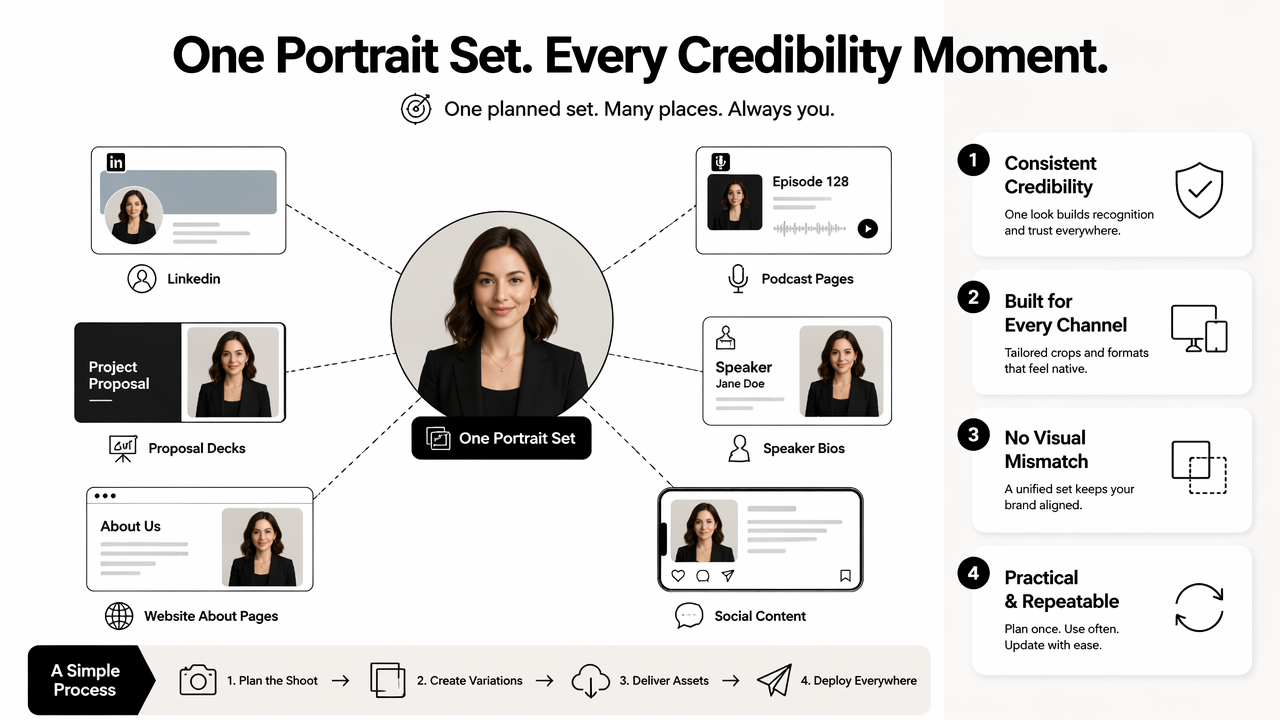
A practical set includes 6 to 12 approved images, not one favorite file. The set should include a primary LinkedIn crop, a website hero crop, a neutral media-kit version, and one warmer photo for founder-led content.
Channel use map for agency portraits
| Channel | Best image style | Why it matters |
|---|---|---|
| LinkedIn profile | Clean, direct, eye-level crop | Supports networking, recruiting, and sales visibility |
| Proposal deck | Polished, confident, neutral background | Makes the founder feel present during evaluation |
| Website About page | Brand-matched lighting and wardrobe | Connects leadership with positioning |
| Podcast guest page | Warm, media-friendly portrait | Helps hosts promote the episode clearly |
| Speaker bio | High-resolution formal image | Works for event pages and PR teams |
| Social thumbnails | Expressive but still professional | Improves recognition across short-form content |
Proposal and pitch assets benefit when the founder photo matches the rest of the deck. Agencies that build sales narratives can pair a portrait set with branded visuals from a pitch deck slide generator so the person, offer, and proof points feel connected.
Podcast appearances deserve the same care. A founder headshot should sit comfortably beside show artwork, guest cards, and episode graphics. For agencies investing in audio or guesting campaigns, a podcast cover generator can help keep guest visuals aligned with the agency brand.
A hiring use case also matters. Founder portraits appear on career pages, recruiter messages, employee advocacy posts, and conference recaps. A consistent portrait can make a small agency feel more established without pretending to be larger than it is.
Which AI headshot style fits each agency type?
The best AI headshot style depends on the agency's business model, clients, and creative promise. A playful founder portrait can work for a creative studio but weaken trust for a B2B demand generation agency. Style should signal the agency's category before a prospect reads the bio.
Style choices should be intentional, not random. Wardrobe, background, expression, lighting, and crop all send positioning cues. In 2026, the strongest portraits look editorial and human, with fewer plastic skin textures and fewer overly dramatic studio effects.
Agency style matrix
| Agency type | Portrait direction | Wardrobe | Background | Avoid |
|---|---|---|---|---|
| Creative agency | Warm, expressive, slightly editorial | Textured shirt, smart casual layers | Soft color, studio wall, creative office | Stiff corporate poses |
| B2B agency | Clear, credible, boardroom-ready | Blazer, knit, crisp shirt | Neutral gray, office, subtle gradient | Trendy filters or heavy retouching |
| Performance marketing | Sharp, direct, data-driven | Dark neutral outfit, minimal patterns | Clean studio or modern workspace | Busy backgrounds |
| Design studio | Minimal, art-directed, calm | Monochrome or refined casual | Architectural, soft light, simple color | Generic stock-photo styling |
A website hero needs more negative space than a profile crop. When agencies place founder photography near a headline, service promise, or booking call-to-action, the image should leave room for text and layout. A website hero image generator can support that wider visual system.
The Looktara platform is useful when an agency owner wants portraits that sit beside other branded assets rather than feeling like a disconnected avatar. The strongest output brief includes agency category, target client, preferred wardrobe, background, and planned channels.
Practical rule: If a portrait would feel out of place on a proposal cover, it is probably too casual for the main LinkedIn image.
How should an agency owner create and approve AI headshots?
Agency owners should create AI headshots through a controlled workflow: gather accurate source images, define brand direction, generate multiple options, review for realism, test crops across channels, and approve a small final set. The process should treat the portrait like brand collateral, not a quick profile update.
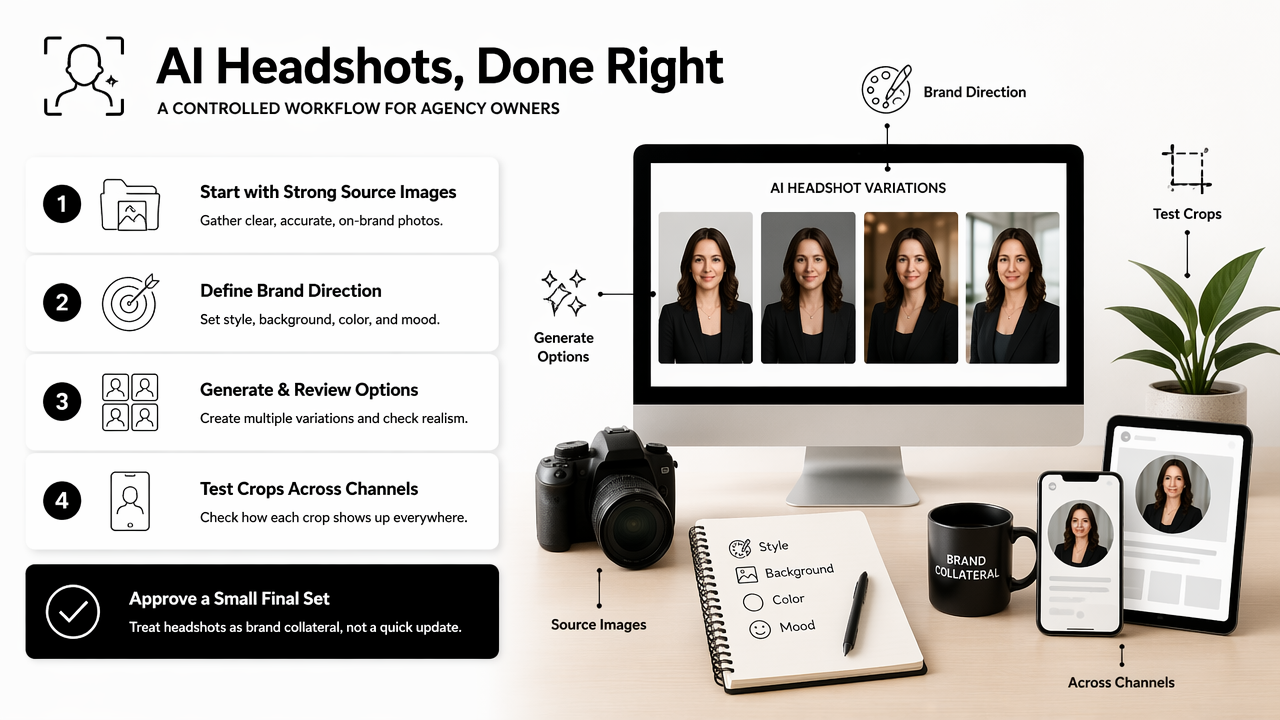
- Collect recent, clear reference photos with varied angles and natural lighting.
- Define the target style using agency positioning, client type, and channel needs.
- Generate several portrait directions rather than relying on a single output.
- Remove images with identity drift, odd hands, strange teeth, distorted glasses, or over-smoothed skin.
- Test the finalists in LinkedIn, proposal, website, and media-kit crops.
- Save approved versions with clear filenames such as
founder-linkedin-primary.jpgandfounder-speaker-bio.jpg.
Approval checklist before publishing
- Identity match: the portrait still looks like the real founder on video calls.
- Brand fit: the clothing, lighting, and expression match the agency's promise.
- Channel fit: the face remains clear in small LinkedIn and social crops.
- Resolution: the file works for web pages, speaker bios, and press requests.
- Consistency: images look related, even when poses and crops differ.
How Looktara handles this is simple: it supports a brand-first image workflow where a headshot can be part of a wider visual kit. Agency owners can create the portrait, then extend the same look into social and sales visuals rather than starting from scratch for every channel.
Related profile assets matter too. A founder updating a LinkedIn portrait may also need a more formal hiring or credential image. A resume headshot generator can support cases where the same person needs a cleaner, employment-oriented version.
One misconception deserves attention. AI portraits should not erase age, facial structure, skin texture, or other recognizable traits. A better goal is presentation quality: clearer lighting, stronger composition, and brand-appropriate styling.
What privacy and ethics checks matter in 2026?
Privacy and ethics checks matter because AI headshots depend on personal images, identity signals, and sometimes biometric-like facial information. Agency owners should review consent, storage, deletion, editing rights, and disclosure norms before using generated portraits in public business contexts.
A 2024 IEEE Access survey by Abenezer Golda, Kidus Abebe Mekonen, and Amit Pandey examined privacy and security concerns in generative AI. For headshots, the practical lesson is straightforward: image inputs deserve the same care as client documents, especially when leadership teams or employees are involved.
Research by Jean-François Bonnefon, Iyad Rahwan, and Azim Shariff on the moral psychology of artificial intelligence also points to a broader trust issue. People judge AI systems not only by output quality, but by perceived fairness, responsibility, and intent.
Milagros Miceli and Julian Posada's work on data production in AI systems adds another useful lens. Behind polished AI outputs sit data practices, labor processes, and governance questions that business users should not ignore.
Responsible-use checklist for agency teams
- Get consent before generating portraits for partners, contractors, or employees.
- Avoid editing someone into a role, setting, or status that misleads clients.
- Keep final portraits realistic enough to match calls, events, and interviews.
- Store approved files in a shared brand folder with usage notes.
- Replace outdated portraits when appearance, positioning, or brand direction changes.
In 2027, agency headshots will likely become more integrated with full brand systems. Expect more tools to generate matching portraits, website visuals, social cards, thumbnails, and speaker graphics from one approved direction. Agencies already producing short-form content can extend founder imagery into video packaging with a YouTube thumbnail generator.
FAQ about AI headshots for agency owners
Are AI headshots professional enough for agency founders?
AI headshots are professional enough when they preserve identity, use realistic styling, and match the agency's positioning. They work best for LinkedIn, proposal bios, About pages, media kits, and speaker pages. They work poorly when the image looks over-edited, changes facial structure, or feels unrelated to the founder's real on-camera presence.
How many headshots should an agency owner create?
A useful portrait set usually includes 6 to 12 final images. That range gives enough variation for LinkedIn, website pages, proposals, podcast guest profiles, speaker bios, and social content without creating visual clutter. The set should share a consistent lighting style, color direction, and level of formality.
Should an agency disclose that a headshot was AI-generated?
Disclosure depends on context. A normal LinkedIn or About page portrait rarely needs a label if it accurately represents the person. Disclosure becomes more relevant when the image places someone in a fictional location, changes visible traits, or appears in a trust-sensitive setting such as press, legal, or regulated industry material.
What makes a bad AI headshot for an agency owner?
A bad AI headshot looks unlike the real person, uses unrealistic skin smoothing, shows distorted details, or signals the wrong market position. For example, a playful creator-style image may hurt credibility for an enterprise B2B agency, while a stiff corporate portrait may feel wrong for an experimental design studio.
Conclusion
An AI headshot for agency owners works best when treated as a brand asset, not a disposable profile picture. The practical next step is to choose the agency style, generate a small portrait set, test it across LinkedIn, proposals, podcast pages, speaker bios, and the website, then save approved files for repeat use.
For a polished founder image system, start with a clear brief, pair portraits with matching content assets, and visit looktara.com when the next brand refresh needs professional visuals without a traditional shoot.
Generated by EarlySEO.com