
A strong AI headshot for portfolio website about page can raise the perceived quality of your site in seconds, but only if it feels real, consistent, and brand-appropriate. In 2026, that bar is higher because people are more aware of AI images, and research shows humans still struggle to reliably spot synthetic faces in some cases, according to a 2023 Journal of Cybersecurity study on deepfake face detection by Bray, Johnson, and Kleinberg. If you want a polished profile image without a studio shoot, The Looktara Lens gives you a practical starting point, especially if you're also building related assets like a resume headshot generator workflow or a matching website hero visual system.
Why an AI-generated portrait can work on an about page
An AI-generated portrait works on an about page when it reduces friction between your image, your message, and your professional identity. Visitors usually decide very quickly whether your site feels current and trustworthy, so the goal is not novelty. The goal is visual alignment.
Your about page photo has a specific job: it should help readers connect your face to your skills, tone, and credibility. That matters for job seekers, consultants, creators, founders, and remote professionals who may not have a recent studio-quality image.
Wikipedia defines stock photography as a supply of photographs licensed for specific uses, a model that has existed since the 1920s. That background matters because your about page should feel personal, not like stock photography. A custom AI portrait can sit between an expensive custom shoot and a generic stock image, as long as it still resembles you.
Key insight: Your portfolio photo should feel like a clear introduction, not a visual effect.
What an about-page headshot needs to communicate
- Recognition: a close resemblance to your real features
- Role fit: styling that matches your field, such as founder, designer, recruiter, or coach
- Consistency: a look that matches your logo, site colors, and other brand assets
- Approachability: natural eye contact, expression, and posture
Quick comparison: AI headshot vs traditional options
| Option | Best for | Main advantage | Main tradeoff |
|---|---|---|---|
| AI headshot | Fast profile refreshes | Lower effort and fast turnaround | Quality varies by prompt and tool |
| Studio photography | Executive branding | Strong control and realism | Higher cost and scheduling |
| Casual self-portrait | Personal brands with informal tone | Feels immediate and real | Often weaker lighting and composition |
| Stock photography | Placeholder use only | Easy to source | Rarely feels authentic for an about page |
If you're building a broader identity system, pairing your portrait with a matching AI logo concept can make your portfolio feel more intentional without overdesigning it.
What an about-page headshot needs to communicate
- Recognition: a close resemblance to your real features
- Role fit: styling that matches your field, such as founder, designer, recruiter, or coach
- Consistency: a look that matches your logo, site colors, and other brand assets
- Approachability: natural eye contact, expression, and posture
Quick comparison: AI headshot vs traditional options
| Option | Best for | Main advantage | Main tradeoff |
|---|---|---|---|
| AI headshot | Fast profile refreshes | Lower effort and fast turnaround | Quality varies by prompt and tool |
| Studio photography | Executive branding | Strong control and realism | Higher cost and scheduling |
| Casual self-portrait | Personal brands with informal tone | Feels immediate and real | Often weaker lighting and composition |
| Stock photography | Placeholder use only | Easy to source | Rarely feels authentic for an about page |
How to choose the right style for your portfolio brand
The right style for your portrait is the one that matches the promise your portfolio makes. A startup founder, UX designer, attorney, and dating coach should not all use the same visual treatment.
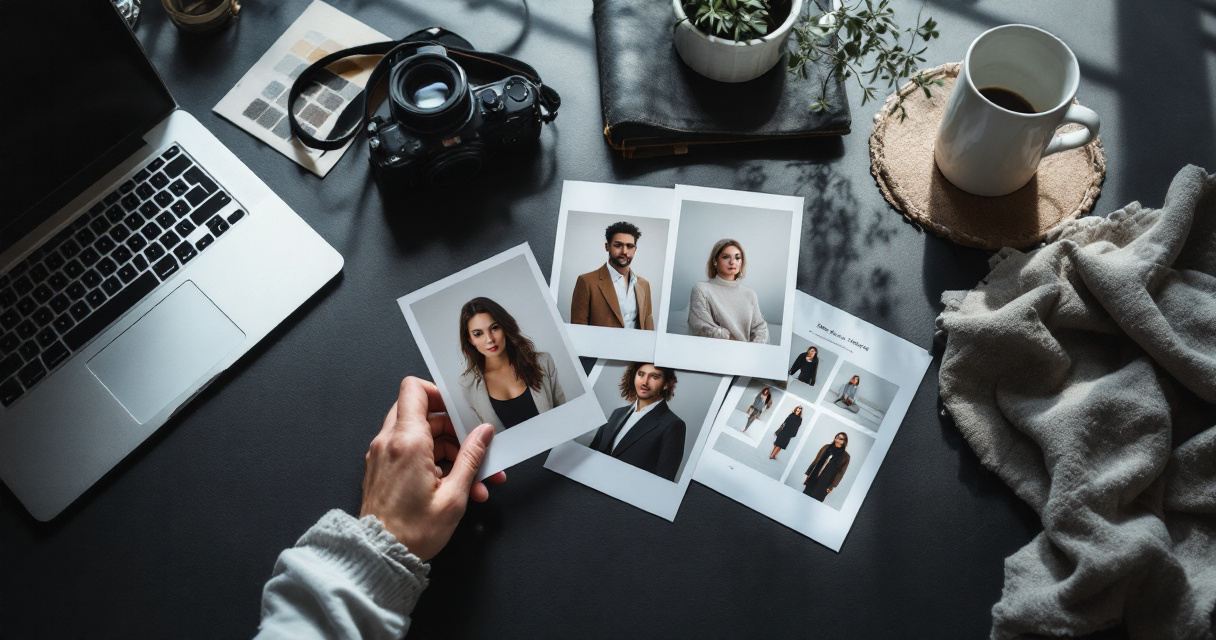
First, decide what your portfolio is selling. If you want clients to trust your judgment, use a clean background, restrained wardrobe, and straightforward expression. If your work depends on personality, such as content creation or coaching, a warmer palette and lighter pose may fit better.
Style choices that usually perform well
- Background: plain, softly textured, or lightly environmental
- Crop: chest-up or shoulders-up for about pages
- Expression: neutral-warm beats exaggerated smiling for most professional uses
- Wardrobe: one level more polished than your everyday look
- Lighting: soft directional light that preserves skin texture
A good rule is to match your strongest traffic source. If recruiters find you through LinkedIn, keep the photo close to your professional profile style. If clients find you through social or speaking gigs, lean slightly more editorial. You can also create asset consistency with related visuals, such as a LinkedIn post creative workflow or a polished pitch deck slide design system.
Your about page image should match the level of formality your visitors expect before they read a single paragraph.
Who should choose which look
| Audience | Best visual direction | Why it works |
|---|---|---|
| Job seekers | Clean, neutral, recruiter-friendly | Feels credible across hiring contexts |
| Entrepreneurs | Confident, brand-forward, modern | Supports authority and memorability |
| Freelancers | Warm and capable | Balances expertise with approachability |
| Creators | Slightly stylized but still realistic | Helps with personal brand recognition |
| Dating profile crossover users | Natural, flattering, honest | Avoids mismatch between site and real life |
The Looktara Lens is especially useful when you need multiple polished variations from one brand direction, not just a single image. That helps when your about page photo also needs to harmonize with banners, social previews, and portfolio thumbnails.
Style choices that usually perform well
- Background: plain, softly textured, or lightly environmental
- Crop: chest-up or shoulders-up for about pages
- Expression: neutral-warm beats exaggerated smiling for most professional uses
- Wardrobe: one level more polished than your everyday look
- Lighting: soft directional light that preserves skin texture
Who should choose which look
| Audience | Best visual direction | Why it works |
|---|---|---|
| Job seekers | Clean, neutral, recruiter-friendly | Feels credible across hiring contexts |
| Entrepreneurs | Confident, brand-forward, modern | Supports authority and memorability |
| Freelancers | Warm and capable | Balances expertise with approachability |
| Creators | Slightly stylized but still realistic | Helps with personal brand recognition |
| Dating profile crossover users | Natural, flattering, honest | Avoids mismatch between site and real life |
What makes an AI headshot believable instead of uncanny
Believability comes from accuracy and restraint, not from making the image look ultra-polished. The biggest mistake is chasing perfection until the result no longer looks like a human photo.
A 2023 study in the Journal of Cybersecurity examined human ability to detect deepfake face images, which is relevant here because your audience may not consciously identify an image as synthetic, but they can still sense when something feels off. Small issues, such as inconsistent skin texture, unnatural hair edges, asymmetrical glasses, or oddly smooth backgrounds, can lower trust even if viewers can't explain why.
Common signs that a headshot is overprocessed
- Skin looks plastic or poreless
- Teeth are unnaturally uniform or too bright
- Eyeglass frames warp near the ears
- Earrings, collars, or buttons don't match left to right
- Stray hairs melt into the background
- Catchlights in the eyes look uneven or artificial
The fix is simple: choose the version that looks most like a good photograph, not the version that looks most expensive. You should compare outputs against recent real selfies in similar lighting and ask one practical question, "Would a colleague recognize me immediately?" If the answer is no, regenerate it.
A simple review checklist before publishing
- Compare the face shape to a recent candid photo.
- Zoom in on hairline, eyes, teeth, and clothing edges.
- Check whether the pose fits your profession.
- Test the image at mobile size and desktop size.
- Place it next to your site colors and typography.
Research by Hoang and Wiegratz in 2022 reviewed machine learning applications in finance, and while it is not about headshots, it reflects a broader reality in 2026: machine learning tools are now used in practical, user-facing workflows. That makes output review more important, not less. Human judgment is still the final quality filter.
Common signs that a headshot is overprocessed
- Skin looks plastic or poreless
- Teeth are unnaturally uniform or too bright
- Eyeglass frames warp near the ears
- Earrings, collars, or buttons don't match left to right
- Stray hairs melt into the background
- Catchlights in the eyes look uneven or artificial
A simple review checklist before publishing
- Compare the face shape to a recent candid photo.
- Zoom in on hairline, eyes, teeth, and clothing edges.
- Check whether the pose fits your profession.
- Test the image at mobile size and desktop size.
- Place it next to your site colors and typography.
How The Looktara Lens fits into a complete portfolio image system
The best portfolio portrait is part of a full visual system, not a one-off file. Your about page image should feel connected to the rest of your website and your off-site profiles.
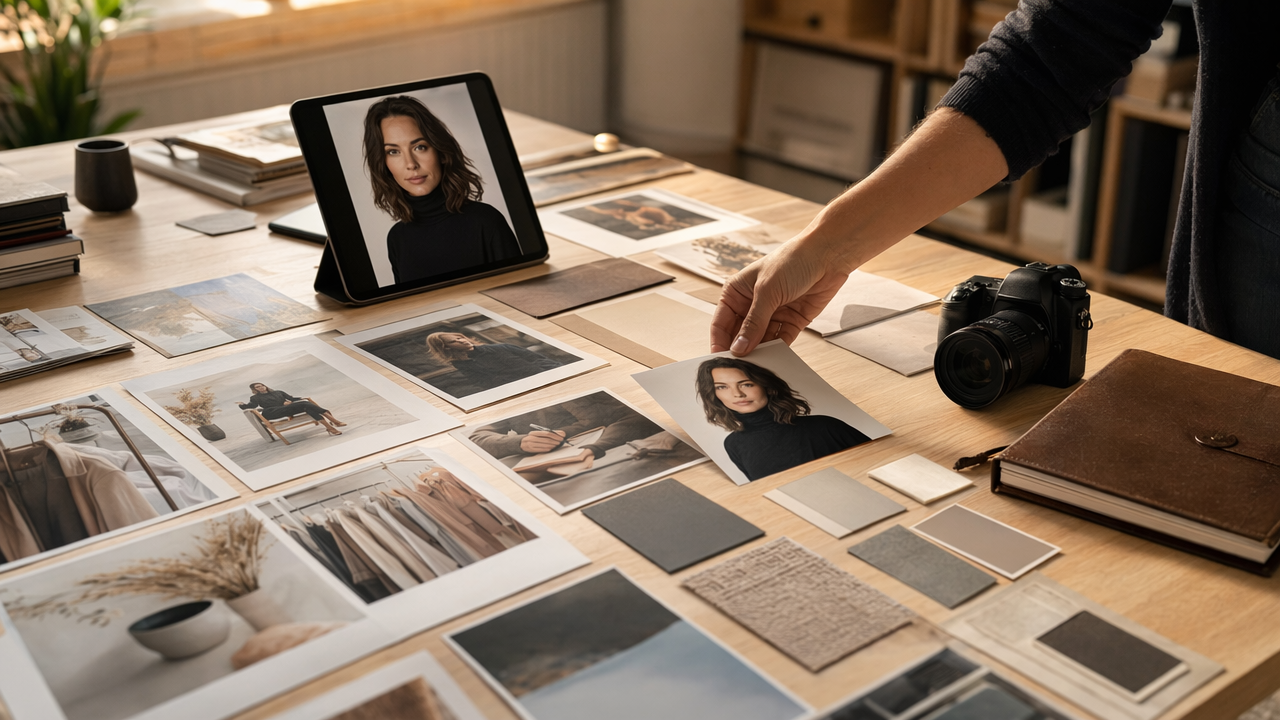
With The Looktara Lens, you can treat your portrait as the anchor asset and then build outward. That means aligning your headshot with homepage visuals, presentation graphics, and social content so your personal brand stays recognizable across touchpoints.
Where to extend the same visual identity
- Your portfolio homepage hero image
- LinkedIn profile and featured posts
- Resume and speaker bio pages
- Pitch decks and founder materials
- Pinterest, TikTok, or short-form content covers
This is where a system helps more than a single image generator. If your site includes a speaking page, founder bio, or product story, you may also want companion visuals such as a podcast cover generator or a Pinterest pin design tool. The image language should feel related, even when the formats change.
How The Looktara Lens handles this
| Need | What to aim for | Why it matters |
|---|---|---|
| About page portrait | Clear, realistic, close-cropped headshot | Builds trust fast |
| Resume photo | Conservative and hiring-friendly | Keeps materials consistent |
| Website hero | Wider composition with brand context | Supports storytelling |
| Social graphics | Adapted crops and visual continuity | Improves recognition |
If you're building several assets at once, The Looktara Lens helps reduce the patchwork look that happens when every image comes from a different tool. For people updating a portfolio before a job search, launch, or rebrand, that consistency is often the real value. For more ideas, head to looktara.com and review the visual tools that support your broader profile.
Where to extend the same visual identity
- Your portfolio homepage hero image
- LinkedIn profile and featured posts
- Resume and speaker bio pages
- Pitch decks and founder materials
- Pinterest, TikTok, or short-form content covers
How The Looktara Lens handles this
| Need | What to aim for | Why it matters |
|---|---|---|
| About page portrait | Clear, realistic, close-cropped headshot | Builds trust fast |
| Resume photo | Conservative and hiring-friendly | Keeps materials consistent |
| Website hero | Wider composition with brand context | Supports storytelling |
| Social graphics | Adapted crops and visual continuity | Improves recognition |
Best practices for publishing an AI headshot on your about page in 2026
Publishing the image well matters as much as generating it well. Placement, file choice, and context affect whether the final result feels premium or awkward.
Keep the image near your short bio, not buried at the bottom of the page. Most people scan first, so a strong portrait paired with a concise value statement usually works better than a large image floating without context. Use an alt tag that describes the person and role, not just "headshot."
A practical publishing workflow
- Pick one primary portrait and one backup variation.
- Export a web-friendly size that stays sharp on retina displays.
- Place it next to your role, credibility markers, and short introduction.
- Check how it looks on mobile before publishing.
- Update related assets so your identity stays consistent.
Accessibility and honesty matter, too. If your generated image is heavily stylized or significantly different from your real appearance, replace it with a more accurate version. Your portfolio is supposed to reduce uncertainty, not create it.
The best AI portrait is the one nobody thinks about because it simply feels like you.
The near future points toward more personalized, multi-format brand systems rather than standalone profile photos. In practical terms, that means your headshot will increasingly need to work across bios, social cards, presentations, and video thumbnails. If you want to build that system without starting from scratch, use your about-page portrait as the reference file, then extend the same look across related assets, including a shorts thumbnail generator. Visit looktara.com when you're ready to refresh your portfolio image stack with a clearer, more consistent direction.
A practical publishing workflow
- Pick one primary portrait and one backup variation.
- Export a web-friendly size that stays sharp on retina displays.
- Place it next to your role, credibility markers, and short introduction.
- Check how it looks on mobile before publishing.
- Update related assets so your identity stays consistent.
Conclusion
A good AI headshot for portfolio website about page should look like you on a very good day, not like a synthetic version of someone else. Focus on resemblance, role fit, and consistency across your site, LinkedIn, resume, and supporting visuals. If you're ready to update more than one asset at once, start with your portrait, then build outward with The Looktara Lens so your whole brand feels connected. Your next step is simple: choose your about-page style, review it against real photos, and publish only the version you'd be comfortable having someone recognize in a meeting tomorrow.
Generated by EarlySEO.com