
Professional headshots once meant booking a photographer, waiting days for edits, and paying hundreds of dollars. In 2026, AI headshot generators can produce dozens of polished portraits in under 30 minutes. But not every tool moves at the same speed. Some deliver results in minutes, others take several hours depending on model training and queue demand. Understanding AI headshot turnaround time helps job seekers, entrepreneurs, and creators choose the right tool when speed matters. Platforms such as The Looktara Lens now generate professional profile images quickly while also supporting other AI visual assets, which makes fast branding updates possible across LinkedIn, websites, and social media.
What 'Turnaround Time' Means in AI Headshot Generation
The phrase turnaround time (TAT) refers to how long it takes to complete a process from request to final output. According to Wikipedia, turnaround time describes the total time required to finish a task or fulfill a request, a concept widely used in manufacturing, computing, and service industries.
For AI headshot tools, turnaround time usually includes several steps:
- Uploading training photos
- AI model training or identity learning
- Image generation
- Rendering and downloading the final portraits
Some platforms perform instant generation using pre-trained models, while others train a custom AI model using your photos. Training increases realism but also increases processing time.
Key insight: Tools that train a personalized model often deliver more realistic headshots, but their turnaround time can be 5 to 20 times longer than instant generators.
Speed also depends on computing resources. Most platforms rely on GPU-based diffusion models similar to Stable Diffusion or custom generative models. When demand spikes, queues can slow delivery.
Typical AI Headshot Turnaround Times in 2026
Testing results from review sites like Briefcase Coach and multiple user experiments published in 2025 and 2026 show large differences between platforms. Some tools produce headshots in minutes, while others take several hours.
Average Turnaround Time by Platform Type
| Tool Type | Typical Wait Time | Output Volume | Use Case |
|---|---|---|---|
| Instant AI generators | 2 to 10 minutes | 20 to 100 images | Social media updates |
| Hybrid generators | 10 to 45 minutes | 40 to 120 images | LinkedIn and resumes |
| Custom model training tools | 1 to 3 hours | 100+ images | High realism portraits |
| Manual retouch services | 24 to 72 hours | 3 to 10 images | Premium corporate headshots |
A 2025 comparison article reported that some tools deliver 100 headshots for around $29 in roughly 10 minutes, while traditional photography often costs $250 or more and requires days for editing.
These rapid times are one reason AI headshots are popular among remote workers and freelancers updating profiles frequently.
Professionals building a full brand identity often combine headshots with other AI visuals. For example, creators may pair portraits with a fitness Shopify website hero AI generator to quickly refresh their site imagery using consistent branding styles.
Turnaround Time Comparison of Popular AI Headshot Generators
Several tools dominate the AI headshot market in 2026. Independent testing by reviewers on Medium and product comparison sites consistently highlights a few key platforms.
Processing Speed Comparison Table
| AI Headshot Tool | Typical Processing Time | Photos Required | Output Images | Notes |
|---|---|---|---|---|
| Aragon AI | 30 to 120 minutes | 10 to 20 | 40 to 100 | High realism training model |
| HeadshotPro | 60 to 120 minutes | 10 to 15 | 100+ | Popular with teams |
| Secta Labs | 30 to 60 minutes | 10 to 20 | 40 to 80 | Strong lighting presets |
| TryItOn AI | 90 minutes to 2 hours | 10 to 20 | 100+ | Includes editing styles |
| Canva AI headshots | 5 to 15 minutes | 1 to 5 | 10 to 30 | Fast but less personalization |
Many reviewers rank Aragon AI highly for realism, while HeadshotPro is frequently used by corporate teams creating employee headshots in bulk.
Speed alone should not be the only factor. Short processing times can sometimes reduce facial accuracy if the system does not train a personalized model.
Why Some AI Headshot Tools Are Faster Than Others
Behind the scenes, AI headshot generators use different architectures and workflows. These design choices directly affect turnaround speed.
Key Factors That Influence Processing Time
Model training requirements Some tools train a unique AI model using your uploaded photos. Training can take 20 minutes to several hours depending on GPU availability.
Cloud GPU capacity High-end GPUs such as NVIDIA A100 or H100 accelerate diffusion models dramatically. Services with larger GPU clusters deliver faster results.
Image resolution settings Generating 1024x1024 or higher resolution images increases compute time compared to smaller previews.
Queue load During peak hours, platforms process thousands of jobs. Queue delays sometimes double the expected time.
Number of variations generated Some services create hundreds of images with different lighting, poses, and outfits. More variations require more compute time.
According to AI image generation benchmarks from OpenAI and Stability AI research, generating high-quality diffusion images can take 2 to 10 seconds per image depending on GPU hardware.
Tools that generate 100 images may therefore require several minutes of compute time even after training completes.
When Faster AI Headshots Actually Hurt Quality
Speed sounds attractive, but ultra-fast generation can sometimes reduce image quality. Many instant tools rely on generalized models that approximate your appearance rather than learning it precisely.
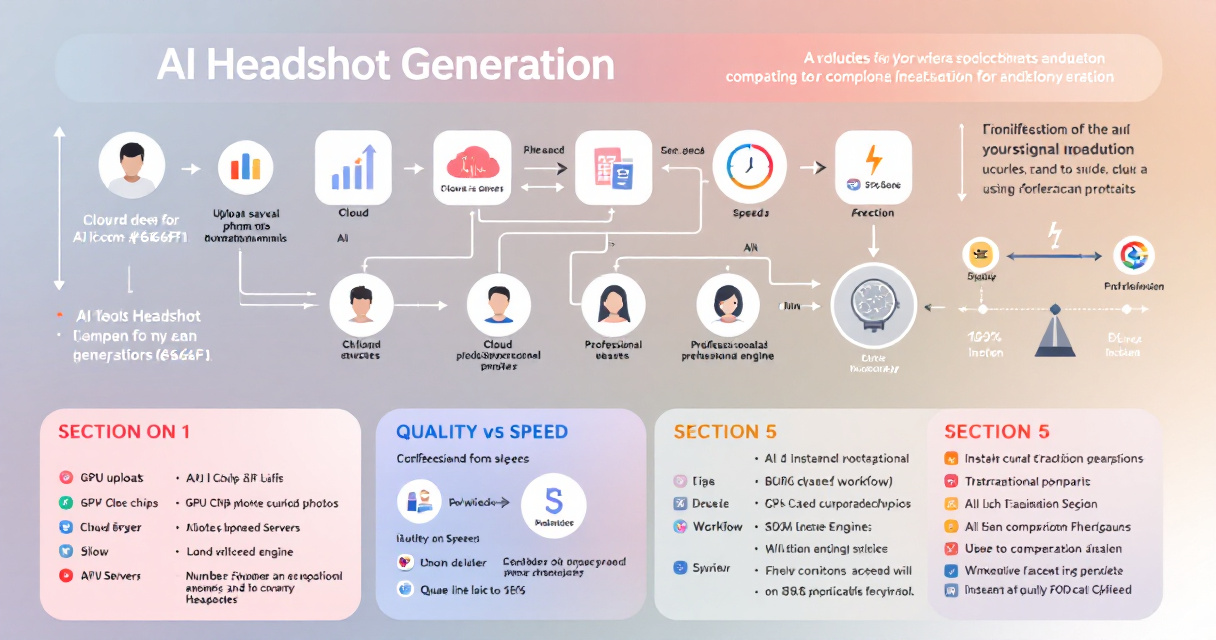
Common issues with extremely fast generators include:
- inconsistent facial structure
- distorted eyes or teeth
- unnatural lighting
- repeated clothing patterns
Signs a Generator Is Rushing the Process
- You upload only one photo
- Results appear in under 60 seconds
- The platform offers only a few image styles
Higher-quality tools request 10 to 20 training images so the model can understand facial geometry, lighting patterns, and skin tones.
Professionals building a full digital brand often prioritize realism over speed. A realistic headshot paired with content like a LinkedIn post graphic AI generator helps maintain a consistent professional presence across platforms.
How AI Headshot Speed Compares With Traditional Photography
Traditional studio headshots follow a very different timeline. Even with a fast photographer, scheduling and editing introduce delays.
Traditional vs AI Headshot Timeline
| Stage | Studio Photography | AI Headshot Generator |
|---|---|---|
| Booking session | 1 to 7 days | Instant |
| Photo session | 30 to 60 minutes | Not required |
| Editing & retouching | 24 to 72 hours | Automated |
| Final delivery | 2 to 5 days | Minutes to hours |
This difference explains the rapid growth of AI headshot tools. Professionals who need quick profile updates often choose AI for speed alone.
Still, studio photography can produce the highest realism for executive portraits and marketing campaigns.
Video: How AI Image Generation Tools Work
Understanding how generative AI creates images helps explain turnaround times and quality differences.
Watch: Overview of Modern AI Image Generators
Diffusion-based models generate images step by step from noise. Each step refines the image until it matches the prompt and training data. This iterative process is why higher quality images require more processing time.
Platforms like The Looktara Lens integrate similar AI image generation technology, allowing users to produce not only headshots but also marketing visuals and social content quickly from the same platform.
How Creators Use AI Headshots Across Multiple Platforms
A professional headshot rarely lives in one place. Modern professionals update several profiles and marketing channels at the same time.
Common places people use AI-generated headshots include:
- LinkedIn profiles
- resume or portfolio websites
- speaking event bios
- podcast guest pages
- social media profiles
Many creators then expand their visual branding with AI design tools. For example:
- A creator might produce profile images with a resume headshot AI generator.
- Then design channel artwork using a YouTube thumbnail generator.
- Finally publish social updates with a Pinterest pin AI generator.
Using one platform for multiple assets reduces design time and keeps visual styles consistent.
What to Expect From AI Headshot Generation in 2027
AI headshot generation continues to improve rapidly as diffusion models and GPUs advance.
Several trends are already emerging:
Trends Shaping the Next Generation of AI Headshots
- Real-time headshot generation with under 60 second processing
- 3D avatar training models that create consistent images from any angle
- Integrated brand asset generation combining headshots with marketing visuals
- Higher resolution outputs, often 4K or greater
AI researchers are also improving identity consistency so the same AI model can generate portraits for different outfits, poses, or backgrounds without retraining.
As these improvements arrive, turnaround time will likely shrink dramatically while realism improves.
Conclusion
AI headshot generators have dramatically reduced the time needed to produce professional portraits. Depending on the platform, you can receive polished images in as little as five minutes or as long as two hours for fully trained models. Instant generators are fastest, while personalized training tools typically produce more realistic results.
If you need professional branding assets quickly, consider tools that combine headshot generation with other AI design capabilities. Platforms like The Looktara Lens allow professionals to create headshots and supporting visuals for websites, social media, and marketing in one place. Start experimenting with AI headshots today, compare turnaround times, and choose a generator that balances speed with image quality for your professional profile.