
TL;DR
Choose between StudioShot and HeadshotPro by confirming how images are produced, who edits them, and what happens when a result needs correction. The supplied research doesn't establish current prices or delivery guarantees, so buyers should request written terms and compare usable results rather than advertised image counts.
A headshot package should be judged by the portraits worth publishing, not the number of files delivered. The StudioShot vs HeadshotPro decision starts with production and editing: generated images, photographer-led work, and human retouching are different services. The available research names both providers but doesn't verify their current production models, so a responsible 2026 comparison must separate established information from purchasing questions. For professionals also exploring brand imagery, Looktara deserves a place on the shortlist alongside a clear brief covering likeness, clothing, background, and intended use.
Table of Contents
StudioShot vs HeadshotPro: What's Actually Verified?
Neither provider's current production and editing model is established by the supplied research, so claims about human retouching or fully automated generation would be premature.
AI headshot generation: Software-based creation of professional-style portraits from reference images.
Human retouching: Person-led editing of an image, distinct from generating a portrait or conducting a photography session.
Revision: A requested change after initial delivery; buyers should distinguish editing an existing image from generating a replacement.
The supplied StudioShot software directory listing establishes a comparison-page presence, not a verified account of its fulfillment process. No equivalent source with current HeadshotPro package terms appears in the research. Calling either service cheaper, faster, or more hands-on would therefore exceed the evidence.
Side-by-Side Evidence and Buying Questions
The table separates missing evidence from the questions that determine practical value.
| Decision factor | StudioShot | HeadshotPro | Buyer's confirmation question |
|---|---|---|---|
| Production model | Not verified in supplied research | Not verified in supplied research | Are portraits generated, photographed, edited, or produced through a combination? |
| Human editing | Scope not verified | Scope not verified | Does a person review every delivered image? |
| Revisions | Current terms not supplied | Current terms not supplied | Are corrections, regenerations, or refunds available? |
| Delivery | Current commitment not supplied | Current commitment not supplied | When does the delivery clock start? |
| Individual purchasing | Package terms not supplied | Package terms not supplied | What does one person receive? |
| Organizational purchasing | Team terms not supplied | Team terms not supplied | Can an administrator manage employees and billing? |
| Integrations | Native connections not verified | Native connections not verified | Are downloads sufficient, or is a connected workflow required? |
Evidence That Can Settle the Production Question
A useful provider response describes the entire process: upload requirements, generation or photography, review, correction, and delivery. Examples alone cannot establish who performs each step.
A polished sample demonstrates an appearance; written service terms establish what a buyer is purchasing.
How Should Buyers Compare Price, Revisions, and Delivery?
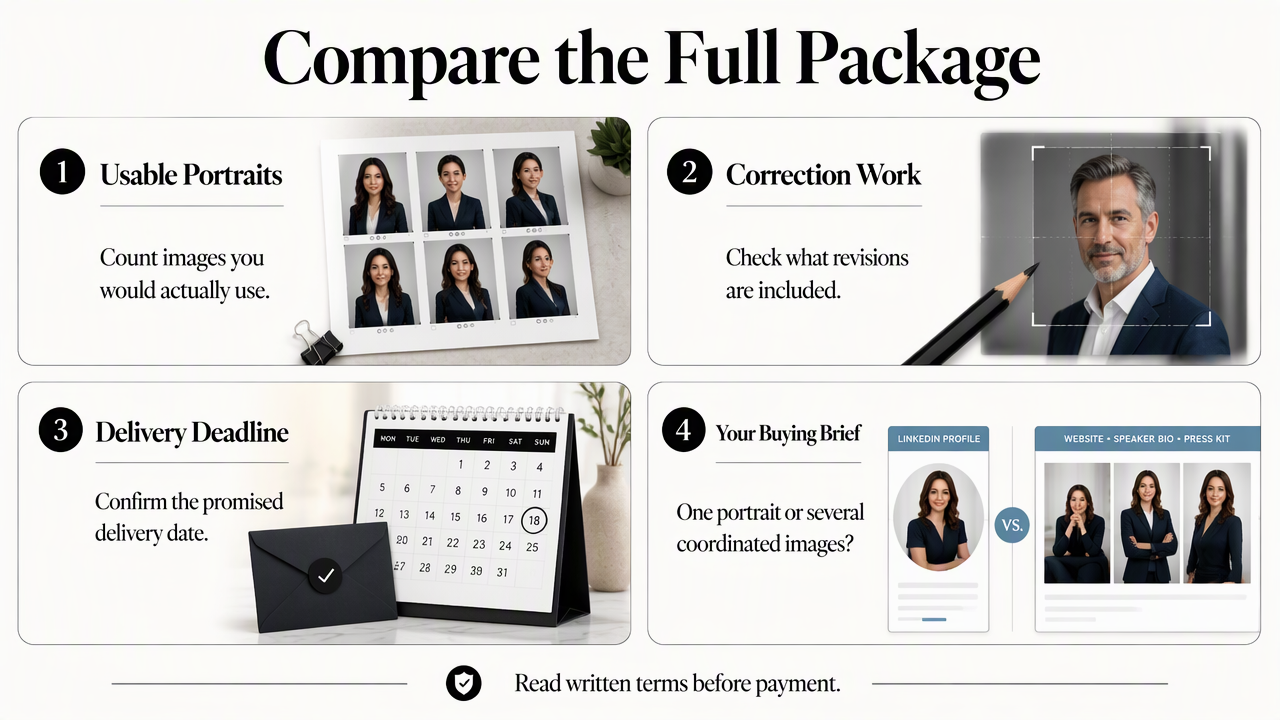
Buyers should compare headshot pricing against usable portraits, included correction work, and the delivery commitment attached to the selected package. A low entry price doesn't establish better value if the required image needs additional work. Written terms should explain the purchase, the correction process, and the deadline before payment.
Calculate Value Around the Required Deliverable
A job seeker may need one convincing LinkedIn portrait. A founder may need several coordinated images for a website, speaker biography, and press materials. These are different buying briefs, even when both begin with the same upload process.
An illustrative comparison: a package producing 20 files is not automatically more useful than one producing five. If only one meets the brief, the other files add little practical value.
- Portrait requirements: Specify crop, expression, clothing, and background.
- Editing scope: Ask whether corrections cover likeness, hair, clothing, and image artifacts.
- Usage rights: Confirm permitted business and personal uses.
- Final files: Confirm resolution, format, and download access.
No current package prices are supplied for either provider. Buyers should compare live checkout totals for equivalent requirements rather than rely on an unsupported price ranking.
Separate Corrections From New Generations
A revision policy should explain whether the provider edits a selected portrait or supplies another set of outputs. These approaches answer different needs: correcting a nearly finished portrait is different from restarting the search for a suitable image.
Delivery commitments also need a starting point. A deadline measured from payment may differ from one measured after upload approval. For an interview, launch, or company announcement, the buyer should request the expected delivery date and the available correction window together.
How Should Teams Evaluate Workflow and Integrations?
Teams should evaluate headshot services through a small pilot, consistent acceptance criteria, and documented administration requirements. Individual image quality is only one part of organizational purchasing. The workflow must also cover employee submissions, approval, billing, file handling, and any required connections to existing company tools before a wider order proceeds.
- Define a shared visual brief for clothing, background, and framing.
- Test the process with a small group of employees.
- Review likeness and consistency against written acceptance criteria.
- Confirm billing, permissions, file delivery, and support responsibilities.
- Approve the wider purchase only after the pilot meets the brief.
Distinguish File Compatibility From Native Integrations
Downloading a portrait and uploading it to LinkedIn is a manual workflow, not proof of a LinkedIn integration. Likewise, a suitable website image doesn't establish a connection to a content management system.
For either provider, buyers should ask whether the workflow supports:
- Centralized employee invitations and order tracking.
- Consolidated invoices and administrator access.
- Agreed filenames, crops, and image dimensions.
- Documented API access or native software connections, if required.
The supplied research verifies none of these capabilities for either service. Teams should treat them as procurement questions rather than advertised features.
Make Data Handling Part of the Pilot
Reference photographs deserve the same purchasing attention as finished portraits. Organizations should request policies covering upload retention, deletion, access, and any use of submitted images for model training.
A useful pilot records the time spent collecting photographs, resolving upload questions, and approving final files. That record gives the organization its own workflow evidence instead of relying solely on a provider's gallery.
Who Should Pick Which Headshot Service?
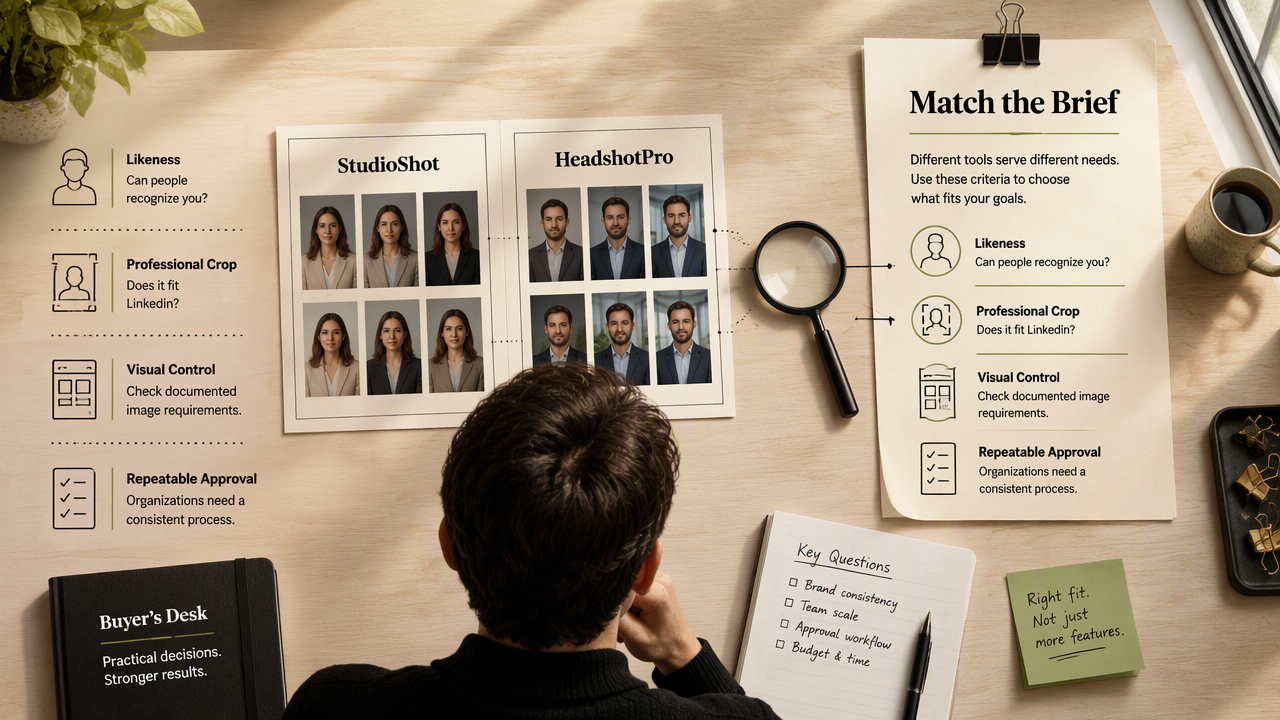
The best choice between StudioShot and HeadshotPro depends on which provider documents a closer match to the buyer's brief, not an unsupported overall ranking. Neither can be declared the winner from the supplied evidence. Individual buyers should prioritize a convincing final portrait; organizations should also require a repeatable purchasing and approval process.
Match the Purchase to the Audience
- Job seekers and remote workers: Favor the provider that demonstrates recognizable likeness and supplies a suitable professional crop.
- Entrepreneurs and creators: Favor documented control over the visual requirements of websites, biographies, and profile images.
- Organizations: Favor verified administration, consistent delivery standards, and clearly assigned correction responsibilities.
- Dating-profile buyers: Prioritize recognizable appearance and believable presentation over heavily stylized business imagery.
The StudioShot comparison listing on Slashdot provides another discovery point, but a directory comparison cannot replace current provider terms. Buyers should request answers to the same brief from both services.
A Brand-Focused Alternative: Looktara
Looktara is another option to explore when the brief extends to professional profile and personal-brand imagery. A shortlist organized around intended use gives buyers a clearer starting point than a list ordered by advertised output volume.
Reviewing the offering at looktara.com can be a useful next step for professionals defining that brief. A LinkedIn portrait, founder biography, and creator profile each deserve explicit requirements for appearance and presentation.
The strongest shortlist starts with the intended use, then compares how each provider proposes to meet it.
Frequently Asked Questions About Choosing a Provider
These answers distinguish what the supplied evidence establishes from what buyers still need to confirm.
Current written package terms should govern the purchase decision.
Is StudioShot Better Than HeadshotPro?
The supplied research doesn't establish that StudioShot is better than HeadshotPro, or the reverse. A fair decision requires verified production methods, comparable package terms, and examples relevant to the intended use. Buyers should submit the same requirements to both providers and compare their written answers before choosing.
Does StudioShot Include Human Retouching?
Human retouching is not verified in the supplied research. Buyers should ask whether a person reviews every image, whether manual editing is included in the selected package, and which changes are permitted. A service description that mentions professional results does not, by itself, establish a human editing process.
Which Service Is Better for Company Headshots?
The better organizational option is the provider that confirms the required team workflow and passes a small pilot. Relevant requirements include employee submissions, shared styling, consolidated billing, approval, correction handling, and data policies. The supplied evidence doesn't verify these capabilities for either service, so company suitability remains a purchasing question.
Conclusion
The StudioShot vs HeadshotPro decision should end with a documented match between the service and the brief. Before purchasing, shortlist providers, request current production and revision terms, and assess representative portraits against explicit requirements. Professionals considering broader brand imagery can also review the Looktara platform with that same brief. The next action is concrete: obtain written answers, then purchase the option that satisfies the required portrait and workflow.
Generated by EarlySEO.com